
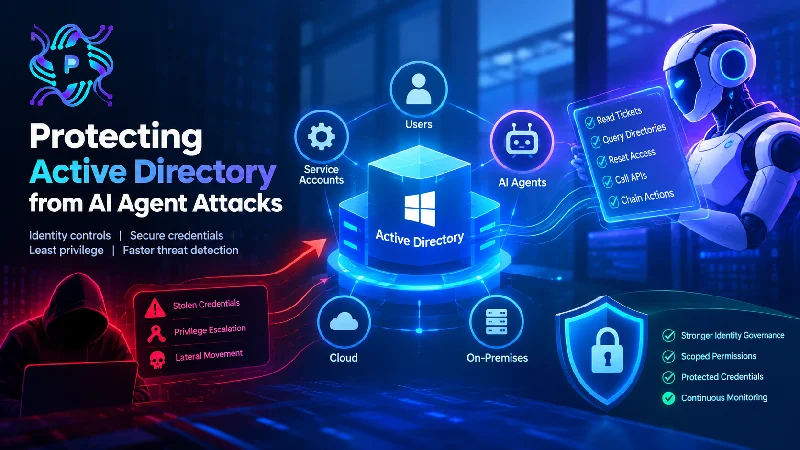
Security teams have spent years modeling threats around two kinds of identity: people and the service accounts that run scheduled jobs. AI agents add a third kind. They read tickets, query directories, reset access, call APIs, and chain those actions together with little human review. An agent needs credentials to do any of that, and those credentials sit in the same environments that attackers already probe.
Active Directory, which still anchors authentication in most large organizations, is directly in the blast radius. The sections below cover where agent identities come from, how their credentials differ from familiar ones, how automation changes timing, and the new routes to privilege that appear when an agent is tricked or compromised.
Agents Create Identities Nobody Planned For
An agent rarely arrives through a formal identity project. A team connects an assistant to a ticketing system, a developer wires one into a deployment pipeline, a department tests an automation that touches shared mailboxes. Each connection needs an identity, and the quickest option is usually an existing service account or a new one created with generous rights to avoid testing failures.
The result is an identity population that grows faster than anyone can track. Records often lack an owner, a purpose, or an expiry date. Some accounts live in Active Directory, others in Entra ID or a SaaS platform, and several share a single secret across tools. When the pilot ends, the project is forgotten, but the account stays.
Security teams already struggle with stale service accounts, and agents multiply the problem because many people outside central IT create them. The first defensive step is plain inventory: find which agents exist, which identities they use, and who answers for each. Discovery can start with authentication logs, looking for accounts that behave like machines: constant intervals, no interactive logons, and access to many unrelated systems. Without that baseline, no later control has anything to attach to.
Agent Credentials Create Standing Access That Attackers Can Collect
Agent credentials differ from human ones in ways that favor intruders. Agents do not get tired, travel, or notice a strange prompt, and they rarely use multifactor authentication. Typically, they hold a long-lived secret such as an API key, client secret, certificate, or a password stored in a configuration file or environment variable. Such secrets leak through code repositories, build logs, chat messages, and the agent’s own context. An attacker who finds one inherits whatever the agent could do, often around the clock, with no user around to report odd behavior.
Scope makes it worse. To avoid failures, agents are often given broad rights: read access across the directory, the ability to modify group membership, or help desk permissions such as password resets. A reset right over a privileged account is effectively that account’s privilege.
Protecting Active Directory from agent attacks starts with treating each agent as a privileged identity subject to the same controls as an administrator. That means short-lived tokens where possible, secrets held in a vault rather than in files, and rights scoped to the single task the agent performs. Where an agent must authenticate inside the domain, group-managed service accounts offer automatic password rotation that a hand-built account lacks.
Speed Changes the Window Defenders Rely On
Many detection and response processes assume that intruders move at human speed. An analyst sees an alert about unusual enumeration, investigates over an hour, and contains the account before the next stage. Automated agents compress that sequence. An agent can enumerate groups, test permissions, and try dozens of credentials across hosts in the time it takes a person to read the first result. Attackers using agent-style automation can also adapt as they go, changing approach after a failed attempt instead of waiting for operator input.
Speed applies to mistakes as well. A legitimately deployed agent with a faulty instruction can modify hundreds of group memberships or disable accounts within minutes, producing damage that resembles an attack and takes time to reverse. Directory changes replicate across domain controllers quickly, so a bad change spreads fast.
Defenders therefore cannot rely on slow review alone. Rate limits on privileged operations, alerts triggered by volume and action type, and automated containment for high-risk events narrow the gap. Teams should also rehearse recovery, because rolling back a damaged directory under time pressure is far easier with tested backups and written runbooks.
New Paths to Privilege Through Delegated Tool Access
An agent that holds legitimate rights can be steered into using them. Prompt injection is the best-known route: instructions hidden in an email, a document, a web page, or a ticket cause the agent to treat attacker text as a task. If that agent can reset passwords or edit groups, the attacker has gained a path to privilege without touching a single credential. The weakness is the authority the agent carries, not a software exploit.
Chained access creates further paths. An agent with rights to a file share, a code repository, and a deployment tool may connect resources that the permission model treats as separate. Another agent may trust output from the first, so a compromise travels sideways through trust relationships rather than network connections. In a hybrid estate, an agent identity synchronized from on-premises Active Directory to Entra ID can carry on-premises rights into cloud roles.
These routes are why a practical program for protecting Active Directory from agent attacks maps agent permissions the same way it maps human ones, using path analysis to ask what an agent identity can reach within three or four hops. Findings such as nested group membership, delegated reset rights, or certificate enrollment permissions should be fixed before an agent gets anywhere near them.
Controls That Fit How Agents Behave
Controls built for people need adjusting for software that acts continuously. A short set of measures covers most of the exposure:
- Give each agent its own named identity, never a shared or borrowed account.
- Limit rights to the narrowest task and review them whenever the agent’s job changes.
- Require human approval for actions that touch privileged groups, domain-level settings, or authentication policy.
- Store secrets in a managed vault and rotate them, preferring short-lived tokens.
- Log every agent action with enough detail to tell its activity apart from a person’s.
Logging deserves extra attention. Alerts based on unusual hours or locations don’t suit an agent that works all day, so detection should compare behavior against the agent’s declared purpose. A password reset agent that suddenly queries replication permissions is behaving out of role, regardless of the time. Decoy accounts or credentials placed where only a misbehaving agent would look can add a precise signal with few false alarms.
Finally, assign an owner and an end date to each agent identity so retired experiments do not leave live credentials behind.
READ: Gaming Updates PboxComputers – Fresh Gaming News & Industry Updates
Final Analysis
AI agents do not replace old Active Directory threats. They add numerous, loosely owned, and often over-permissioned identities, and they act faster than the review cycles built around human administrators. The defensive response draws on familiar practice: inventory every identity, scope rights tightly, protect secrets, and map the paths from each identity to Tier 0. What changes is the pace and the need for explicit approval gates on sensitive actions. Organizations that treat agent identities as privileged from the start avoid the slow accumulation of rights that made service accounts a recurring weakness.