
An AI feature can pass every test before launch and still misbehave on its first busy afternoon. Users type things nobody anticipated, retrieved documents contain instructions no developer wrote, and the model answers the same question differently on different days. Traditional application security assumes that code behaves the same way each time it runs, so a scan or a review can vouch for it. Applications built on language models break that assumption, because their behavior depends on inputs that arrive after deployment.
That gap explains why controls that operate while the application is live have become a standard part of AI security design. The sections below cover what runtime guardrails are, how they address prompt injection and data leakage, how output filtering and policy enforcement work, and the gaps teams most often leave open.
Why Pre-Release Testing Cannot Carry the Whole Load
Testing an AI application resembles testing a conversation more than a function. The set of possible inputs is effectively unlimited, and the output is generated rather than looked up. A red team can probe hundreds of adversarial prompts before launch and still miss the phrasing a curious user finds on day three.
Context makes the problem harder. Many applications retrieve documents, call tools, read emails, or browse the web, and each source brings text the developers did not control. A support assistant that summarizes an inbound customer message may ingest an instruction hidden in that message. Nothing in the source code changed, yet the application’s behavior did.
Models also change. Providers update hosted models, teams swap versions, and fine-tuning shifts behavior subtly. A prompt that produced safe output last month may drift. Static checks of prompts and code remain useful, but they describe the system at one moment under assumed conditions. Runtime controls observe what actually enters and leaves the system and can respond in the moment, which is the only point at which some attacks become visible.
Where AI Runtime Protection Sits in the Architecture
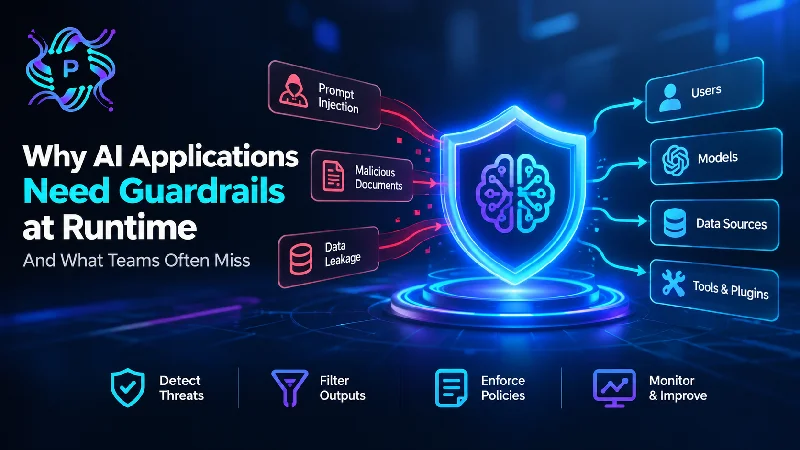
AI runtime protection refers to controls that inspect and govern the live traffic between users, models, data sources, and tools. Rather than trusting the model to police itself, the application places checkpoints around it. Those checkpoints can sit in several places: a gateway or proxy in front of the model API, a library embedded in the application, or a sidecar service that evaluates requests and responses.
Typical checkpoints run at four moments. Input checks examine the user’s message and any retrieved content before the model sees it. Context checks verify that the documents pulled into a prompt are ones the user may access. Tool-call checks review actions the model proposes, such as sending an email or running a query, before they execute. Output checks inspect the final response before it reaches the user or a downstream system.
Design choices involve trade-offs. Every checkpoint adds latency, so teams decide which checks run synchronously and which run in the background. Detection models used for classification can themselves be wrong. Rule-based checks are predictable but brittle, while model-based checks generalize better and produce more uncertainty. A layered approach, with cheap deterministic rules first and heavier analysis reserved for risky cases, usually balances cost, speed, and coverage.
Prompt Injection and Data Leakage
Prompt injection occurs when supplied text changes the model’s instructions. Direct injection comes from the user, who may write something like a request to ignore previous rules. Indirect injection arrives through content the application fetches, such as a web page, a PDF, or a calendar invite containing hidden instructions. The indirect form is harder to spot because the user did nothing wrong, and the malicious text rides in with trusted-looking data.
The consequences depend on what the model can do. A chatbot with no tools can only produce bad text. An agent with access to email, files, or internal systems can be steered into forwarding data, changing records, or calling services. That connection between injection and capability is why limiting permissions matters as much as detecting attacks.
Data leakage takes several forms. A model may repeat sensitive material from its system prompt, reveal personal data from retrieved documents, or surface content the current user should not see because retrieval ignored access controls. Users may also paste confidential information into prompts sent to external providers. Controls include scanning inputs and outputs for patterns such as credentials and personal identifiers, enforcing document-level permissions during retrieval, and redacting sensitive fields before text leaves the organization. No detector catches everything, so reducing what the model can reach is the stronger defense.
Output Filtering and Policy Enforcement
In most AI runtime protection designs, output filtering evaluates what the model produced before anyone acts on it. Common checks screen for harmful or off-policy content, leaked secrets, personal data, unsupported claims, and formats that could cause damage downstream. An often overlooked case is output that becomes code or markup. If an application renders model text as HTML, runs it as a query, or passes it to a shell, an attacker who influences the output may gain execution, so treating model output as untrusted input is essential.
Policy enforcement turns an organization’s rules into checks the system applies consistently. A policy might state that the assistant must not give legal advice, must not discuss unreleased products, or may only call a refund tool for amounts under a threshold. Written as machine-checkable rules, such policies can block, modify, or escalate a response. Human review fits cases with high stakes, such as financial transactions or messages sent to customers.
Clarity about actions matters. A guardrail should decide among a few responses: allow the request, block it with a safe message, redact part of it, or route it for approval. Logging each decision, with the reason, supports audits and tuning. Policies should live outside the prompt where possible, because instructions placed in a prompt can be overridden by the same injection techniques they are meant to resist. Enforcing rules in code, outside the model’s reach, gives them a reliability that natural-language instructions lack.
What Teams Often Miss
Experience across deployments shows a recurring set of gaps:
- Treating the model as the only thing to protect while ignoring tools, plugins, and connectors with real privileges
- Filtering user input but skipping retrieved documents, tool results, and other indirect sources
- Granting agents broad service credentials instead of per-user, least-privilege access
- Logging too little, or logging sensitive prompts without protecting the logs themselves
- Launching guardrails once and never measuring false positives, false negatives, or drift
- Forgetting that streaming responses can leak content before a filter finishes its check
Monitoring deserves particular attention. Teams need dashboards showing blocked requests, unusual tool usage, and spikes in sensitive-data detections, along with a process for reviewing them. Findings should feed back into prompts, policies, and tests, so that each incident improves the next release.
Testing continues after launch. Replaying real traffic against updated guardrails, running regular adversarial exercises, and tracking model version changes keep the controls honest. Ownership is another quiet gap, since AI applications sit between security, platform, and product teams, and nobody may feel responsible for the runtime layer. Naming an owner, setting thresholds, and defining an escalation path turns guardrails from a one-time project into an operating practice.
Key Takeaways
Language-model applications behave differently at runtime than in testing, so protection has to operate while the system is live. Checkpoints around inputs, retrieved context, tool calls, and outputs let teams detect injection attempts, limit leakage, and enforce policy in code rather than in prompts.
The most reliable defenses reduce capability as well as detect abuse: least-privilege access for agents, permission-aware retrieval, and treatment of model output as untrusted. Teams that monitor results, test continuously, and assign clear ownership avoid the common gaps and keep their guardrails useful as models and attackers change.