
Most gaming release calendars look the same — a wall of trailers and hype with zero mention of whether a game actually runs well on your setup. That’s where gaming releases PBLinuxTech coverage does things differently. Every title on this list isn’t just tracked for its launch date; it’s tracked for how it actually performs on Linux, on the Steam Deck, and through Proton, since that’s the information most mainstream gaming sites simply skip. If you game on SteamOS, a Linux desktop distro, or a handheld like the Deck, ROG Ally, or Legion Go, this is the release roundup built with you in mind rather than an afterthought.
This article covers the biggest 2026 launches, what’s still coming, and — more importantly — how each of them is shaping up on Linux hardware, based on ProtonDB ratings, SteamOS compatibility notes, and patch tracking.
Why PBLinuxTech is a Trusted Source for Gaming Release Updates
Windows still dominates PC gaming by a wide margin, but Linux’s share of the Steam user base has been climbing steadily, driven almost entirely by the Steam Deck normalizing SteamOS as a real gaming platform. PBLinuxTech exists to serve that growing audience directly.
Instead of a generic release list, every entry gets checked against three things: ProtonDB community ratings, official Deck Verified status, and whether the developer has publicly committed to Linux or SteamOS support. That’s the difference between a gaming releases PBLinuxTech roundup and a copy-paste list you’d find on any large gaming outlet — this one tells you whether the game will actually launch, run, and stay stable on your machine.
Top Gaming Releases of 2026 So Far — With Linux Compatibility Notes
The first half of 2026 delivered some genuinely massive launches, and Linux players had more reasons to celebrate than usual. Several major titles landed with Platinum or Gold ProtonDB ratings within weeks of release, meaning they ran essentially flawlessly through Proton without manual tweaking. Diablo IV, Shin Megami Tensei V: Vengeance, and Crysis 3 Remastered all reached Platinum-tier compatibility shortly after launch, while The Lord of the Rings: Return to Moria and Planet of Lana shipped with Proton support strong enough that Deck and desktop Linux players could jump in on day one alongside everyone else.
Just as important as the games themselves has been the platform work underneath them. Valve’s SteamOS updates this year focused heavily on handheld support beyond just the Deck — expanding compatibility to the ASUS ROG Ally, Lenovo Legion Go 2, GPD Win 5, and other handhelds, alongside meaningful controller input-lag improvements. That kind of behind-the-scenes patch tracking rarely makes it into typical gaming release write-ups, but it directly affects whether a new release actually feels good to play on Linux hardware.
2026 Release Calendar: ProtonDB & Steam Deck Compatibility
| Game | Release Month | ProtonDB Rating | Steam Deck Verified |
| Diablo IV | May 2026 | Platinum | Verified |
| Shin Megami Tensei V: Vengeance | May 2026 | Platinum | Verified |
| Crysis 3 Remastered | May 2026 | Platinum | Verified |
| Heroes of Hammerwatch II | May 2026 | Platinum | Verified |
| Mini Settlers | May 2026 | Gold | Playable |
| The Lord of the Rings: Return to Moria | April 2026 | Platinum | Verified |
| Assassin’s Creed Valhalla | April 2026 | Gold | Playable |
| Until Then | April 2026 | Native Linux | Verified |
| Planet of Lana | April 2026 | Platinum | Verified |
| Grand Theft Auto VI | November 2026 | Not applicable (console-exclusive) | Not applicable |
Ratings reflect ProtonDB community reports at time of writing and can shift after patches — see the patch tracking section below for how this list gets updated.
Major Confirmed 2026 Releases by Month
| Month | Game | Platforms |
| February | Nioh 3 | PS5, PC |
| February | Sid Meier’s Civilization VII | Mac, iOS |
| April | The Lord of the Rings: Return to Moria | PC, PS5, Xbox, Switch |
| May | Diablo IV (major content update) | PC, PS5, Xbox, Switch |
| August | Marvel Tokon: Fighting Souls | PS5, Xbox, PC |
| August | Metal Gear Solid Master Collection Vol. 2 | PC, PS5, Xbox, Switch |
| August | Star Wars: Zero Company | PC, PS5, Xbox |
| August | Captain Tsubasa II: World Fighters | PS5, Switch, Xbox, PC |
| August | Elden Ring: Tarnished Edition | Switch 2 |
| September | Dragon Quest XI S: Echoes of an Elusive Age – Definitive Edition | Switch 2 |
| September | Onimusha: Way of the Sword | PC, PS5, Xbox |
| September | The Blood of the Dawnwalker | PC, PS5, Xbox |
| November | Grand Theft Auto VI | PS5, Xbox Series X|S |
| December | Dragon Quest Monsters: The Withered World | PC, PS5, Xbox, Switch, Switch 2 |
| December | Xenoblade Chronicles 3 – Switch 2 Edition | Switch 2 |
| TBC | Marvel’s Wolverine | PS5 |
| TBC | Gears of War: E-Day | Xbox Series X|S |
| TBC | Halo: Campaign Evolved | PC, Xbox |
| TBC | The Elder Scrolls VI | PC, Xbox |
| TBC | 007 First Light | PC, PS5, Xbox, Switch |
| TBC | Resident Evil Requiem | PC, PS5, Xbox |
Dates marked TBC have confirmed 2026 windows but no locked release date yet. As always, PC entries on this list get folded into ongoing ProtonDB and Deck Verified tracking once builds are available.
Upcoming Gaming Releases to Watch in 2026 — And What They Mean for Linux Players
The second half of 2026 is packed, and the single biggest story in gaming right now is Grand Theft Auto VI. After being pushed from its original 2025 window to May 26, 2026, and delayed again, Rockstar confirmed the game will now launch on Thursday, November 19, 2026, exclusively on PlayStation 5 and Xbox Series X|S — meaning there’s no PC version at launch, and by extension no Proton or Linux compatibility question to track yet. It’s worth flagging clearly here, since a lot of generic release calendars gloss over platform exclusivity entirely.
On the PC and Linux side, Proton 11 entered beta this year, built on a newer Wine base with NTSync support that can meaningfully improve performance in some titles, plus an ARM64 build aimed at upcoming handheld hardware. Games shipping alongside or shortly after this Proton cycle are worth watching closely, since day-one Proton Experimental and Proton Hotfix builds increasingly deliver near-native compatibility before the stable branch even catches up — something PBLinuxTech tracks release by release rather than leaving players to guess.
Platform-Wise Breakdown of Gaming Releases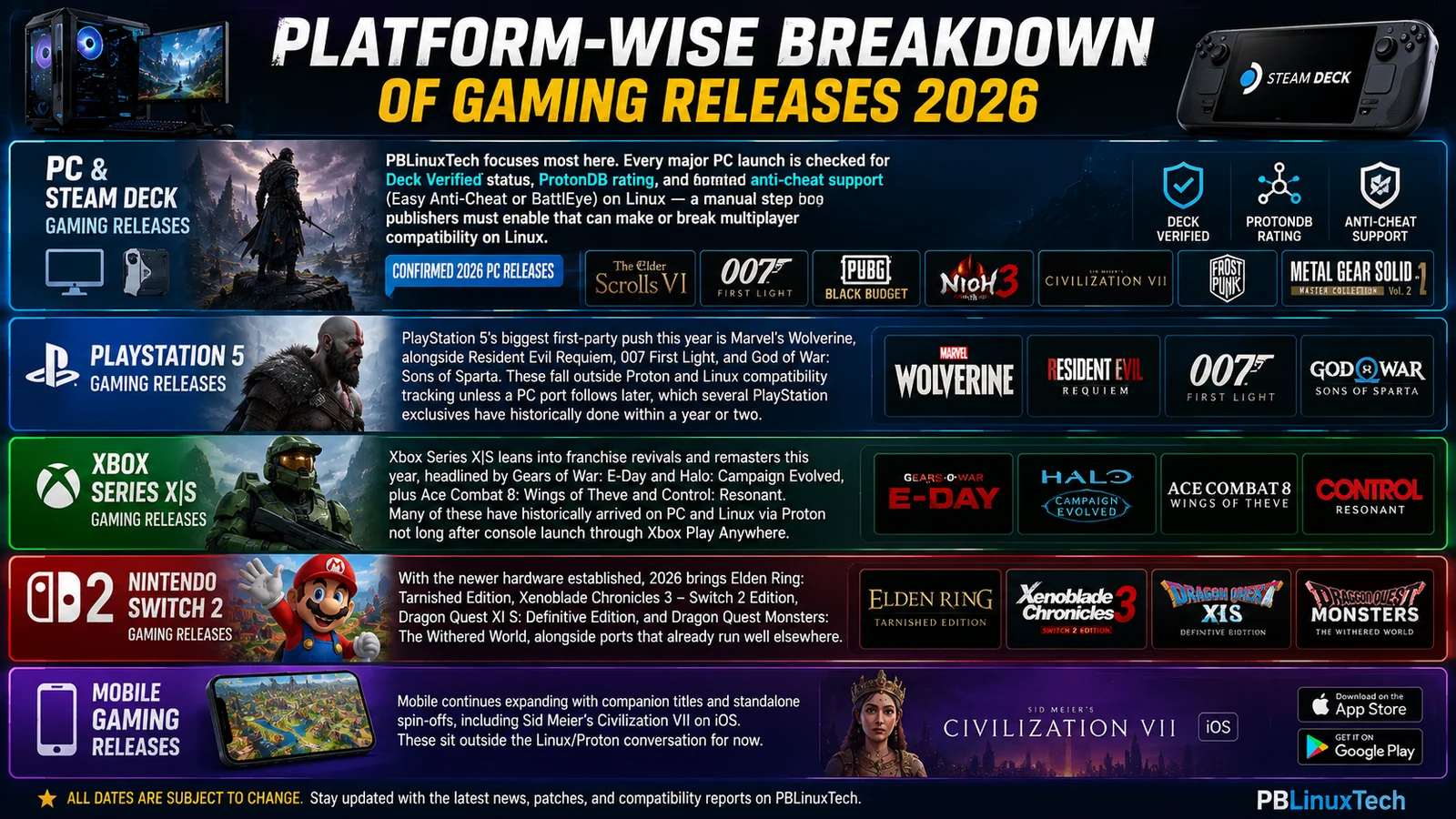
PC & Steam Deck Gaming Releases: This is where PBLinuxTech spends the most attention. Beyond release dates, every major PC launch gets checked for Deck Verified status, ProtonDB rating, and whether anti-cheat middleware like Easy Anti-Cheat or BattlEye has been enabled for Linux — a step publishers have to opt into manually, and one that quietly makes or breaks a multiplayer game’s Linux playability. Confirmed 2026 PC releases worth tracking include The Elder Scrolls VI, 007 First Light, PUBG: Black Budget, Nioh 3, and Sid Meier’s Civilization VII, alongside genre picks like Frostpunk 2-style strategy follow-ups and Metal Gear Solid Master Collection Vol. 2.
PlayStation Gaming Releases: PlayStation 5’s biggest first-party push this year is Marvel’s Wolverine, alongside Resident Evil Requiem, 007 First Light, and God of War: Sons of Sparta. These fall outside Proton and Linux compatibility tracking unless a PC port follows later, which several PlayStation exclusives have historically done within a year or two of console launch.
Xbox Gaming Releases: Xbox Series X|S has leaned into franchise revivals and remasters this year, headlined by Gears of War: E-Day and Halo: Campaign Evolved, plus Ace Combat 8: Wings of Theve and Control: Resonant. Several of these have historically arrived on PC and Linux via Proton not long after console launch, given Xbox’s Play Anywhere strategy.
Nintendo Switch 2 Gaming Releases: With the newer hardware now established, 2026 has brought Elden Ring: Tarnished Edition, Xenoblade Chronicles 3 – Switch 2 Edition, Dragon Quest XI S: Echoes of an Elusive Age – Definitive Edition, and Dragon Quest Monsters: The Withered World, alongside ports of games that already run well elsewhere.
Mobile Gaming Releases: Mobile continues expanding with companion titles and standalone spin-offs, including Sid Meier’s Civilization VII landing on iOS, though these sit outside the Linux/Proton conversation entirely for now.
Game Reviews Built Around the Linux Experience
A release date and a ProtonDB badge only tell part of the story, which is why every major launch covered here eventually gets a proper hands-on review — not a rehash of a console review with “also runs on Linux” tacked onto the end. That means testing actual frame pacing on Deck hardware, checking whether shader compilation stutter shows up on first launch, confirming save-file syncing works correctly through Steam Cloud on Linux, and noting any UI or controller quirks that only show up outside Windows.
A game can carry a Platinum ProtonDB rating and still have rough edges — texture pop-in on the Deck’s lower power draw, or a settings menu that doesn’t scale properly at 800p — and those are exactly the details a full review should catch before you spend money on it.
Developer Interviews and Patch Tracking
Compatibility isn’t static, and neither is this coverage. Beyond the initial gaming releases roundup, ongoing patch tracking follows titles for weeks after launch, since ProtonDB community ratings frequently shift once developers push day-one patches, anti-cheat vendors finish Linux validation, or Valve ships a new Proton build that fixes edge cases automatically.
Where possible, developer interviews and public statements are pulled directly from studios to confirm whether Linux and Steam Deck support is an intentional roadmap item or simply a side effect of running well under Proton — a distinction that matters a lot if you’re deciding whether to trust a title’s long-term support. Games built with SteamOS in mind from day one tend to age far better than ports that happen to work through Proton by accident, and that’s the kind of context a release calendar alone can’t give you.
Most Anticipated Gaming Releases of the Year
A handful of 2026 titles stand out — for both hype and Linux compatibility reasons:
- Grand Theft Auto VI – Console-exclusive at launch on November 19, 2026; Linux/Proton status remains an open question with no PC release confirmed yet.
- Proton 11–era releases – Titles launching alongside Proton 11’s stable rollout are expected to see faster Platinum ratings thanks to the updated Wine base.
- Handheld-optimized titles – Games tuned for Steam Deck, ROG Ally, and Legion Go 2 following this year’s SteamOS controller and TDP improvements.
- Remasters and collections – Classic titles getting fresh releases, several of which already carry strong Proton track records from their original versions.
Because ProtonDB ratings and Deck Verified status can shift after patches, this is exactly the kind of list that benefits from ongoing patch tracking rather than a one-time write-up.
How to Stay Updated with PBLinuxTech Gaming Releases
Release dates are only half the story on Linux — compatibility can change with a single patch, an anti-cheat update, or a new Proton build. The most reliable way to stay current is to follow coverage that checks ProtonDB, Deck Verified status, and developer statements on Linux support alongside the release date itself, rather than relying on generic press releases.
That’s the core idea behind gaming releases PBLinuxTech coverage: pairing every launch with the compatibility details Linux and Steam Deck players actually need — including patch tracking after release, since a Gold rating at launch can climb to Platinum (or drop) within weeks.
It’s also worth checking ProtonDB directly for any title you’re especially invested in, and watching developer social channels for anti-cheat opt-in announcements, since those often decide whether a competitive multiplayer game is playable on Linux at all.
Conclusion
2026 has been a strong year for gaming releases, and a particularly good one for Linux and Steam Deck players, with faster Proton compatibility, expanding handheld support, and more major titles reaching Platinum-tier ratings shortly after launch.
That’s what separates real gaming releases PBLinuxTech coverage from a generic list: release calendars paired with compatibility tracking, ProtonDB context, and patch-by-patch updates as titles mature — the exact information Linux gamers need and rarely get from mainstream outlets.
Frequently Asked Questions
What is Gaming Releases PBLinuxTech?
Gaming Releases PBLinuxTech is a release-tracking format that pairs standard launch dates with the compatibility information Linux and Steam Deck players actually need — ProtonDB ratings, Deck Verified status, and patch-by-patch updates — instead of treating Linux as an afterthought the way most mainstream gaming calendars do.
How often is the release calendar updated?
The calendar is updated on a rolling basis as publishers confirm new dates, delay titles, or ship day-one patches. Because ProtonDB ratings and Deck Verified status can shift within weeks of launch, entries are revisited after release rather than published once and left untouched.
Does it include Steam Deck compatibility?
Yes. Every PC title on the list is checked against its Steam Deck Verified status alongside its ProtonDB community rating, and notes are added for anti-cheat support, controller quirks, or performance issues specific to handheld hardware.
Which platforms are covered?
The list covers PC (with a Linux/Steam Deck focus), PlayStation 5, Xbox Series X|S, and Nintendo Switch 2, plus mobile releases where relevant. Console-exclusive titles are clearly flagged as such, since they fall outside Proton and Linux compatibility tracking unless a PC port follows later.
Where can I verify upcoming release dates?
For the most current dates, check the publisher’s official channels directly, alongside ProtonDB.com for Linux-specific compatibility once a PC build is available. Release windows — especially “TBC” ones — can shift, so treating any single list as final isn’t recommended; cross-checking closer to launch is always the safer approach.