
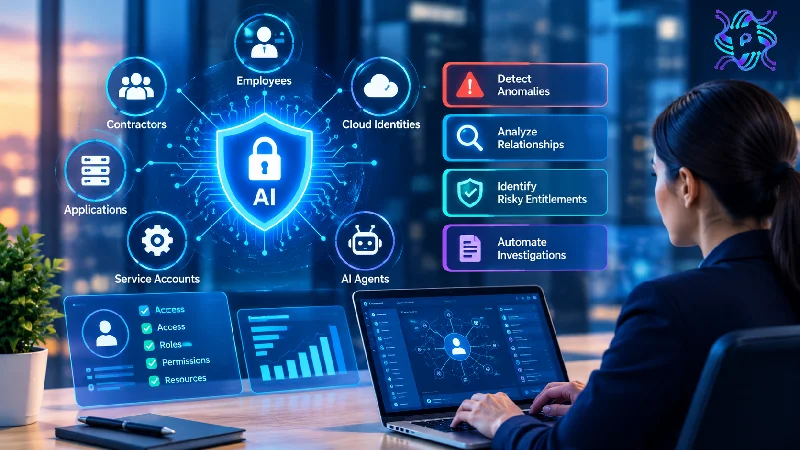
Security teams have access to more identity data than ever, but more information doesn’t automatically make threats easier to find. Modern environments contain employees, contractors, applications, service accounts, cloud identities, and AI agents, each creating relationships between users and resources.
Artificial intelligence can help security teams analyze those relationships faster. Instead of relying only on fixed rules or manually reviewing long permission lists, AI-based systems can spot unusual patterns, investigate relationships, and help analysts understand why an identity may pose a risk.
The technology has real potential, but it also has limitations. AI should support security judgment rather than replace policy, verification, and human accountability.
Identity Threat Detection Starts With Context
A single permission does not always indicate risk. An administrator account may be appropriate for one employee but dangerous for another. A service account with broad access may be necessary for a particular application while creating unacceptable exposure elsewhere.
Context helps security teams distinguish normal activity from suspicious activity.
AI systems can analyze identity relationships, permissions, roles, resources, and other available information to identify patterns that deserve attention. This helps analysts prioritize investigations instead of manually reviewing every account.
The quality of the result depends heavily on the underlying data. If identity information is incomplete, outdated, or disconnected across systems, an AI model may lack the context to make a useful assessment.
Anomaly Detection Can Surface Unusual Behavior
Anomaly detection is one of the most discussed uses of AI in security. The basic concept is straightforward: understand normal patterns and flag activity that differs enough to warrant investigation.
In identity security, anomalies can include unusual access relationships, unexpected privilege changes, or behavior that doesn’t fit an identity’s normal role.
AI can help rank these events and explain why they may be unusual. This can reduce the time analysts spend sifting through raw data.
However, unusual behavior does not automatically mean malicious intent. Employees change roles, projects create temporary requirements, and administrators sometimes perform legitimate emergency actions. Security teams therefore need to investigate and verify before treating an anomaly as a confirmed threat.
Finding Risky Entitlements at Scale
Organizations often struggle to identify excessive permissions because access can accumulate through groups, roles, applications, and inherited relationships.
An AI-driven identity security approach can analyze these relationships and identify combinations that deserve closer attention. For example, an account may have access to several sensitive resources even though its current role no longer requires them.
The useful output is not simply a warning. Analysts need context explaining how the access was obtained, what resources are affected, and what action may reduce the risk.
An organization evaluating AI-driven identity security should therefore examine whether the system can connect findings to actual identity and entitlement data rather than generating generic security recommendations.
Automated Investigation Can Reduce Analyst Work
Identity investigations can consume significant time when analysts must collect information from multiple systems before understanding what happened.
AI can assist by bringing relevant identity relationships and access information together and producing an investigation summary. Linx describes its AI-powered security assistant as being grounded in its Identity Graph and capable of providing investigation reports, answers, recommendations, and supporting context.
That approach can help analysts move from question to investigation more quickly.
Automation should still include appropriate safeguards. Analysts need to know where conclusions came from and should be able to verify important findings before making consequential access decisions.
AI Has Limits in Identity Security
AI can identify patterns, summarize information, and speed investigations, but it doesn’t automatically understand business intent.
An access relationship may look unusual because an employee is temporarily supporting another department. A service account may have broad permission because an application genuinely requires it. A sudden change may be legitimate emergency work.
False positives can therefore create unnecessary workload if AI systems are not carefully tuned.
Security teams should also consider data quality, model transparency, privacy, authorization boundaries, and the possibility of incorrect recommendations. Treat AI output as decision support, especially when removing access could disrupt critical business operations.
Combining AI With Existing Security Controls
AI does not replace identity governance, access policies, authentication, or least-privilege principles. It can work alongside them.
A useful architecture may use AI to identify risky relationships, governance systems to review permissions, and automated workflows to apply approved changes.
The combination can create a stronger feedback loop. AI identifies a potential problem, an analyst or policy evaluates it, and an authorized workflow can remediate the issue.
That model keeps accountability with the security organization while using automation to reduce repetitive investigation work.
Building an AI-Assisted Identity Strategy
Organizations adopting AI for identity security should start with clear use cases. They might start with anomaly detection, entitlement analysis, investigation support, or prioritizing access risks.
The technology should then be evaluated against real identity data and actual security workflows. Teams should measure whether analysts can investigate faster, whether false positives remain manageable, and whether recommendations are understandable.
AI is most useful when it provides better context without hiding uncertainty. Security teams still need policies, human review, and reliable identity data.
The future of identity security is unlikely to be entirely manual or entirely autonomous. AI can handle much of the analysis while people remain responsible for judgment, governance, and decisions that affect access to critical systems.