
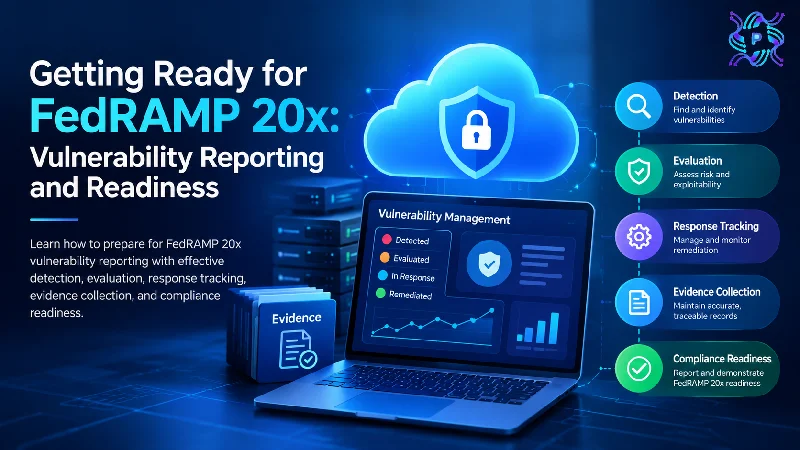
Vulnerability management under FedRAMP 20x is broader than running a periodic vulnerability scanner. Providers are expected to maintain an ongoing process for discovering, evaluating, responding to, and reporting vulnerabilities affecting their cloud service offering.
That shift matters because vulnerabilities can emerge between formal assessments. A cloud environment can change rapidly, and a weakness that was absent during one review can appear after a deployment, configuration change, new dependency, or newly disclosed security issue.
What Vulnerability Detection Means Under 20x
FedRAMP’s current 20x rules describe vulnerability detection as a persistent process rather than a single scan. Providers are expected to systematically discover and identify vulnerabilities using appropriate techniques, which can include scanning, threat intelligence, penetration testing, automated control testing, supply-chain monitoring, and other capabilities.
The scope also extends beyond traditional software vulnerabilities. FedRAMP notes that failures in security processes can themselves become vulnerabilities. An outdated control statement or ineffective detection process may therefore require attention.
For security teams, this means vulnerability management needs to connect multiple information sources. A scanner is useful, but it cannot provide the full picture on its own.
The process should also account for changes. New resources should enter the detection process, while significant changes should trigger appropriate reassessment.
Vulnerability Evaluation Comes After Detection
Finding a vulnerability is only the beginning. Teams must determine what the finding means in the context of the cloud service.
FedRAMP’s current vulnerability evaluation rules require providers to assess whether detected vulnerabilities are likely exploitable. The rules state that providers must assume exploitation can be automated unless evidence shows otherwise.
That makes contextual information important. Teams need to know which resource is affected, whether it is reachable, what service it supports, and the potential impact of exploitation.
False positives also need appropriate handling. A finding that does not represent a real vulnerability should not remain mixed with confirmed issues, because doing so can make reporting less useful.
Prepare for Persistent Reporting
Reporting is a major part of the 20x model. Current FedRAMP rules require providers to report vulnerability detection and response activity persistently, summarizing activity since the previous report.
The rules also require relevant providers to submit monthly human-readable reports. Machine-readable formats are also important because structured data supports automated processing.
Teams should therefore prepare the underlying data before producing a report. If vulnerability records are stored inconsistently across spreadsheets, tickets, and security tools, creating a reliable report becomes difficult.
A useful reporting process should preserve timestamps, tracking identifiers, evaluation information, exploitability status, impact information, and, where applicable, remediation progress.
Prepare the Right Evidence Before Certification Work Accelerates
Readiness begins with understanding what data already exists. Security teams should identify the systems that produce vulnerability information and determine whether those systems can provide consistent historical records.
FedRamp 20x VDR and VER readiness should therefore include more than selecting a scanner. Teams need processes for detection, evaluation, response, evidence preservation, and reporting.
The exact terminology matters. FedRAMP currently uses VDR for Vulnerability Detection and Response and VER for Vulnerability Evaluation and Reporting. Those concepts are related but address different stages of the vulnerability lifecycle.
Separating those stages helps teams avoid a common mistake: assuming that finding a vulnerability automatically satisfies the reporting requirement.
Common Readiness Gaps to Address
Several gaps can make vulnerability reporting difficult. One is incomplete asset visibility. If a provider does not know what resources exist, it cannot reliably demonstrate that vulnerability detection covers the environment.
Another is inconsistent timestamps. Detection, evaluation, mitigation, and remediation events should be traceable.
A third problem is disconnected tooling. If scanner results remain isolated from ticketing systems and compliance records, teams may struggle to prove what happened after a vulnerability was discovered.
Teams should also examine how they handle exceptions. Current FedRAMP rules distinguish mitigation from remediation and provide specific treatment for unresolved vulnerabilities.
READ: Trending News PBoxComputers Latest Tech & Gaming Updates in 2026
Key Takeaways
FedRAMP 20x vulnerability readiness is a continuing operational process. Providers need reliable detection, contextual evaluation, response tracking, and persistent reporting.
Strongest preparation starts with asset visibility and consistent data. Security teams should know where vulnerability findings originate, how they are evaluated, how remediation is tracked, and how the resulting information becomes certification data.
Automation can reduce repetitive work, but the underlying process still requires skilled security judgment. The objective is to create a system that keeps vulnerability information accurate, traceable, and available when agencies and other authorized parties need it.