
Security leaders rarely get to choose between two clean options. Budgets are fixed, audit calendars are fixed, and the number of applications keeps growing. When a new category of tooling promises penetration-test-like results at a different price and pace, the sensible question is not whether it is better but where it fits among the methods already in use.
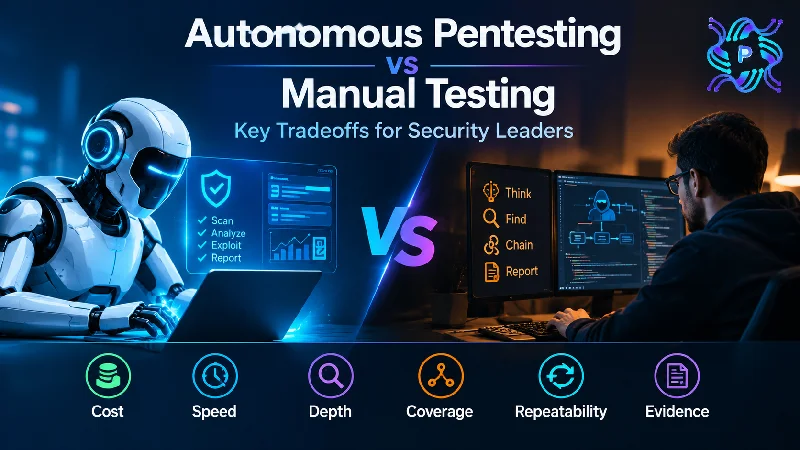
The comparison between machine-driven and human-led testing involves several dimensions: cost, speed, depth, coverage, repeatability, and the evidence each produces. Neither approach wins on all of them. The sections below set out the tradeoffs in terms leaders can use for planning, then describe how to combine the two in a program that is affordable and credible to boards, customers, and auditors.
Two Ways to Probe a System
Manual penetration testing is performed by experienced practitioners who study a target, build a mental model of how it works, and look for ways to break it. They bring creativity, intuition, and an understanding of how real attackers behave. A good tester notices that an odd error message hints at a deeper flaw, or that two minor weaknesses can be chained into a serious one.
Automated approaches have existed for years in the form of scanners, which compare systems against known issues and run quickly across many assets. Newer systems go further by using AI agents that choose actions, adapt to responses, and attempt to exploit weaknesses in sequence, much as a person would. They aim to provide validated findings, meaning issues demonstrated to be exploitable, rather than raw lists.
The differences stem from how each works. Human testers are limited by time, availability, and cost, but they can improvise brilliantly. Machine-driven systems scale across assets and time, but their reasoning, though improving, remains less reliable in unfamiliar situations. Both can miss things, and both can overstate or understate risk if poorly managed.
Leaders should therefore frame the decision around objectives. Is the aim to satisfy a compliance requirement, to reduce risk across a broad estate, to test a critical system in depth, or to maintain steady confidence between major releases? Different goals favor different mixes.
Cost and Speed
Cost structures differ considerably. Manual engagement is priced by effort, typically scoped in days or weeks, and reflects the scarcity of skilled testers. Thorough testing of a complex application can be expensive, so many organizations limit manual testing to a few critical systems and run it once a year.
Autonomous pentesting is generally priced so repeated runs are more affordable, though pricing models vary, from subscriptions to usage-based fees. The marginal cost of another test, such as after a release, tends to be lower. That changes the economics of frequency, making it feasible to test more applications and to retest after fixes without a new statement of work.
Speed varies too. Scheduling a manual engagement may take weeks, execution takes days, and reporting follows. Machine-driven tests can start quickly, run in parallel across assets, and produce results within hours or days, depending on scope. Retesting a fix can happen almost immediately.
Speed has caveats. Faster results are useful only if teams can act on them, so remediation capacity becomes the new bottleneck. Cost comparisons should also include internal effort: reviewing findings, handling false positives, managing access, and integrating results into workflows. When assessing autonomous pentesting, leaders should measure total cost per validated finding, not just the tool’s price, and compare it with the same measure for manual work.
Depth and Creativity
Depth is where human expertise remains strongest. Experienced testers excel at understanding business context, such as how a financial workflow could be abused, and at spotting logic flaws that no signature would match. They can combine social engineering, physical access, or unusual technical techniques, and they can explain subtle risk to executives.
Machine-driven tools show strength in breadth and persistence. They can systematically try many variations, follow long chains of steps, and examine every endpoint without fatigue. For common vulnerability classes, such as injection, broken access control, misconfigurations, and exposed secrets, they can reach confirmed findings quickly and consistently.
The gap in depth is narrowing but not closed. Even so, autonomous pentesting systems may struggle with unusual application logic, multi-step workflows that depend on human context, and defenses that require improvisation. Output quality depends on the models, the tooling, and how well scope and credentials are provided. Leaders should evaluate tools on realistic applications from their own environment, comparing results to those of a skilled human tester and noting both unique finds and misses.
Reporting also differs. Humans provide narrative, business-context prioritization, and recommendations tailored to the organization. Automated systems provide evidence, reproduction steps, and consistent formats, which developers often find practical, though executive audiences may need human review of the narrative.
Coverage, Repeatability, and Evidence
Coverage over time differs significantly. Manual tests are snapshots: they describe a system on the days it was tested. Systems that change weekly drift rapidly from that snapshot. Machine-driven testing can run continuously or on triggers, keeping coverage closer to the system’s current state.
Repeatability supports engineering workflows. A consistent test that can be rerun after a fix gives developers a clear definition of done, and regression checks prevent old problems from returning. Human testing is less repeatable because different testers may follow different paths and report differently, though that diversity of perspective is also valuable.
Evidence needs differ by audience. Auditors and customers often ask for a report from an independent third party, and a manual engagement by a recognized firm satisfies this expectation in a way that is widely understood. Machine-generated reports are gaining acceptance, but acceptance varies by auditor, framework, and customer, so leaders should confirm requirements before replacing manual reports.
Safety and control also matter. Manual testers are accountable individuals who can exercise judgment about risk during an engagement. Automated systems need strong guardrails, scoping, and monitoring to avoid unintended impact. Both approaches require clear rules of engagement and logging, and both benefit from a defined escalation path when something unexpected occurs.
Combining Them in One Program
For most organizations, the answer is a layered program that assigns each approach to the work it does best. A practical allocation looks like this:
- Use continuous or frequent automated testing for broad coverage across applications and after each significant change
- Use manual expert testing for critical systems, new architectures, and complex business logic
- Use automated retesting to verify fixes quickly and detect regressions
- Reserve independent third-party reports for compliance, customer assurance, and board reporting
- Feed results from both back into engineering practices, such as secure coding guidance and threat modeling
Planning begins with a risk-ranked inventory. Identify which systems justify deep human attention and which benefit mainly from steady, broad coverage. Pilot automated testing on a few applications and compare its output with the latest manual assessment. Measure validated findings, time to remediate, false-positive rate, and cost.
Governance ties it together. Define who owns the program, what rules of engagement apply, how findings are triaged, and how results are reported. Revisit the mix annually as tools improve and the environment changes. Whatever the allocation, clearly communicate to the board and auditors what each method covers so expectations match reality.
End Note
The choice between machine-driven and human-led testing is rarely an either-or decision. Automation brings scale, speed, and repeatability, while skilled people bring depth, creativity, and context. Costs and capabilities differ enough that a blended program usually delivers more assurance per dollar than either alone.
Security leaders who define objectives first, test tools against their own environment, keep experts focused on the hardest problems, and confirm what auditors will accept can build a testing program that keeps pace with change. Success is measured not by which method is used, but by how quickly real weaknesses are found, confirmed, and fixed.
Leaders who document the reasoning behind their mix will find it easier to adjust later. As the tools mature and audit expectations settle, the balance can shift without starting over because the objectives, measurements, and responsibilities are already documented.